
Severe Underside Corrosion At Mid-Lap
| Case Study
Overview
This case study documents a severe instance of concealed corrosion within the lap joints of a profiled metal roof, resulting in the complete loss of the lower sheet across the purlin line.
The condition was identified during inspection despite the absence of internal water ingress, highlighting the risk of significant hidden deterioration within lap joints.
Roof Construction (Observed)
- Profiled metal roof (material not confirmed on site)
- Built-up construction with internal lining panels
- Mid-lap overlaps with applied sealant
- Roof supported on steel purlins
Note: The outer sheet material was not tested on site. Observations are based on visible condition only.
General Roof Condition (Topside)
From a top-side inspection:
- The roof appears broadly serviceable
- Isolated corrosion spots and coating degradation are visible
- Mid-lap joints have been previously sealed
- No widespread failure of the outer sheet is immediately apparent
Importantly: The roof was not actively leaking internally at the time of inspection.
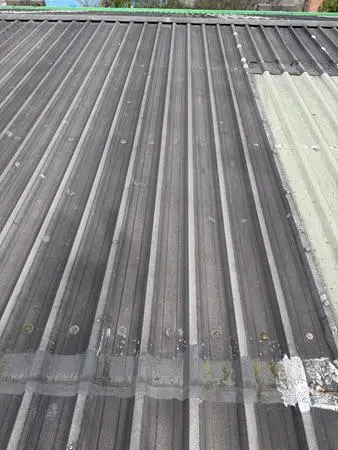
General Roof Condition: Appears broadly serviceable with no obvious indication of concealed failure.
Progression of Deterioration At Mid-Lap Joints

Complete loss of the original protective finish throughout the roof

Historical cut edge corroison treatment with sealed mid-lap joint & spot-corrosion

Perforations evident to the uppermost sheets at the mid-lap joints

Loss of structural integrity to the bottom sheets at the mid-lap joints
Key Finding
The lower sheet had corroded to the extent that no intact structural material remained, with the lap effectively held together by the applied sealant.
From above, the roof appeared serviceable. Within the lap, the sheet had already failed.
Condition Within the Lap
Inspection into the lap void confirmed:
- Absence of continuous lower sheet material
- Remnants adhered to the upper sheet
- Material loss occurring within the joint
The primary deterioration has occurred out of sight within the lap.
Important Observation
The most severe deterioration is occurring where moisture is retained—not where exposure is greatest.
Where lap joints have been sealed or previously treated, consideration should be given to how moisture may behave within the system over time.
Reason for Refusal
Structural integrity compromised at the support line
Defect extends beyond surface corrosion
Coating would not restore structural capacity
The roof was assessed as unstable and unsuitable for a coating-based repair.
Summary
- Severe concealed corrosion within lap joints
- Complete loss of lower sheet at purlin line
- No internal leakage despite structural failure
- Driven primarily by moisture retention
- Repair not viable using coating systems
Inspection Footage – Internal Condition at Mid-Lap
This footage shows the condition within the lap joint following localised failure.
The lower sheet has completely deteriorated within the joint, with no continuous material remaining across the purlin line.