
Industrial Roof Life Expectancy:
A Surveyor's Guide
How Long Should an Industrial Metal Roof Last?
The Short Answer
There is no fixed lifespan for an industrial metal roof.
Some roofs require extensive repairs after 20 years, while others remain suitable for refurbishment after 40 years or more.
The determining factor is usually condition, not age.
A roof's service life can be influenced by its design, location, maintenance history, exposure to corrosive environments and even the activities carried out within the building itself.
For this reason, two roofs of the same age can have very different refurbishment options.
Why Industrial Roof Lifespan Varies So Much
Industrial roofs are exposed to a wide range of conditions throughout their service life.
Factors that may influence durability include:
- Roof type and construction.
- Geographic location.
- Coastal or industrial exposure.
- Original factory-applied coating system.
- Maintenance history.
- Drainage performance.
- Previous repairs or modifications.
- The activities carried out within the building.
Whilst age is often used as a guide, it is rarely the most important factor when assessing the condition of an existing roof.
The Hidden Factor: What Happens Inside the Building
Many roof surveys focus on the external condition of the roof covering. However, some of the most significant deterioration can occur from within the building itself.
Industrial processes involving chemicals, acids, high humidity, steam or corrosive vapours can attack the underside of metal roof sheets.
In some cases, this deterioration may remain hidden until a detailed inspection is carried out.
We have encountered roofs where internal processes have caused severe corrosion to the underside of roof sheets, despite the external surface appearing to remain in relatively good condition.
Even where the original tenant has vacated the premises, residual contamination can continue to affect future refurbishment works.
This is one of the reasons why age alone should never be used to determine whether a roof is suitable for refurbishment.

The tenant's acid bath processes led to the internal failure of the finish to this steel roof liner.
What Matters More Than Age?
When assessing whether an industrial roof may be suitable for refurbishment, the following areas are often more important than the roof's age:
Corrosion
Surface corrosion may be manageable, whilst more advanced corrosion can affect the long-term viability of refurbishment.
Cut Edge Condition
Cut edge corrosion is one of the most common defects found on ageing metal roofs and should be assessed carefully.
Fixings
Missing, loose or heavily corroded fixings can significantly affect roof performance.
Rooflights
Brittle or deteriorated rooflights may require replacement as part of any refurbishment project.
Gutters
Failed gutters can often become the first point of water ingress and may require separate remedial works.
Underside Corrosion
Hidden corrosion to the underside of roof sheets can significantly affect refurbishment options.
Real-World Example
It is not unusual to find a well-maintained 40-year-old roof that remains suitable for refurbishment.
Equally, we have encountered roofs less than 20 years old where severe corrosion, poor detailing or aggressive internal environments have resulted in significant deterioration.
The age of the roof alone rarely tells the full story.
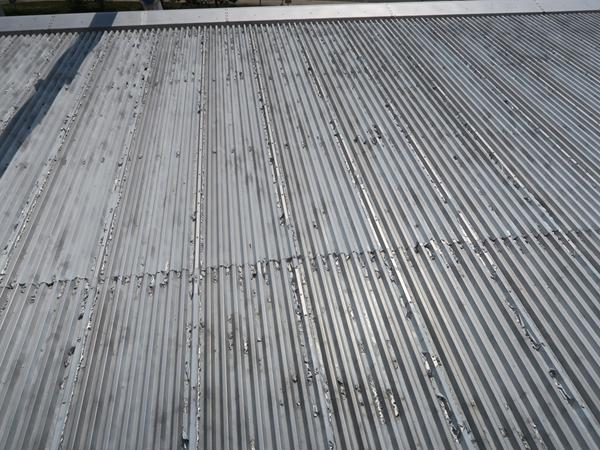
The image opposite shows a PVDF coated roof with widespread surface delamination, which is highly unusual for this kind of finish. on a roof of this age.
In this case, it is likely that the initial primer was either missed or was incorrect for the final application of the PVDF finish.
Conclusion
When considering the future of an industrial metal roof, the most useful question is not:
"How old is the roof?"
Instead, ask:
"What condition is the roof in today, and what defects are likely to affect its future performance?"
Only once those defects have been identified can the suitability of refurbishment, overcladding or replacement be properly assessed.
A detailed inspection of the roof's condition will usually provide a far more reliable indication of remaining service life than its age alone.
If you are assessing an ageing industrial roof, our Industrial Metal Roof Inspection Checklist explains the key areas that should be reviewed during a condition survey.
Additonal Reading: Industrial Metal Roof Inspection Checklist