

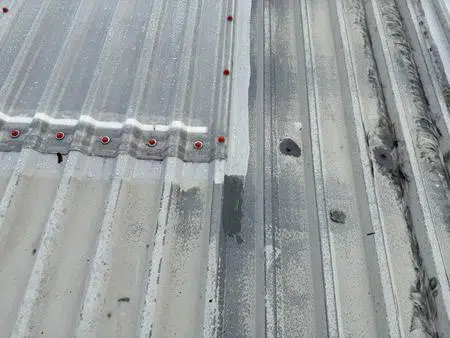
This Bitesize CPD note examines how the term “moisture tolerant” is commonly used in relation to roof coatings, and why its interpretation on steel substrates matters in professional specification and defect assessment.
Bitesize CPD – Technical Context
The term “moisture tolerant” is frequently used in relation to roof coating systems, but its meaning on steel substrates is often misunderstood. Unlike porous materials, steel does not retain internal moisture; it is either wet or dry at the point of application. This distinction has a direct bearing on adhesion, inter-coat compatibility, and long-term performance at laps and day joints.
When you see the terms “moisture tolerant” on manufacturers’ web sites and social media posts, it’s easy to conclude that the coating can be applied in wet conditions. That’s simply not true.
For a detailed technical explanation of how coating chemistry, substrate condition, and certification scope interact on metal roofs, refer to the following technical guidance note:
Silicone vs STP Technology in Roof Coatings
https://liquasil.com/roof-defect/silicone-v-stp-technology-in-roof-coatings
This reference material supports informed specification and defect assessment in the context of cut edge corrosion, overlaps, and dilapidations reporting.
CPD learning outcome
After reviewing this material, practitioners should be able to:
-
distinguish between environmental moisture resistance and surface condition at application
-
understand how different polymer technologies behave at joints and day interfaces
-
apply this understanding when assessing coating suitability on steel roofs
Reflective question
How does the distinction between moisture tolerance and dry-substrate adhesion influence your approach to specifying or reviewing roof coating systems on metal roofs?